What an oil-to-gas conversion does to your chimney
The boiler was replaced. The chimney was not. That single mismatch is the most common finding in pre-war Essex County housing, and it works on the masonry from the inside for years before anybody notices.
The short answer
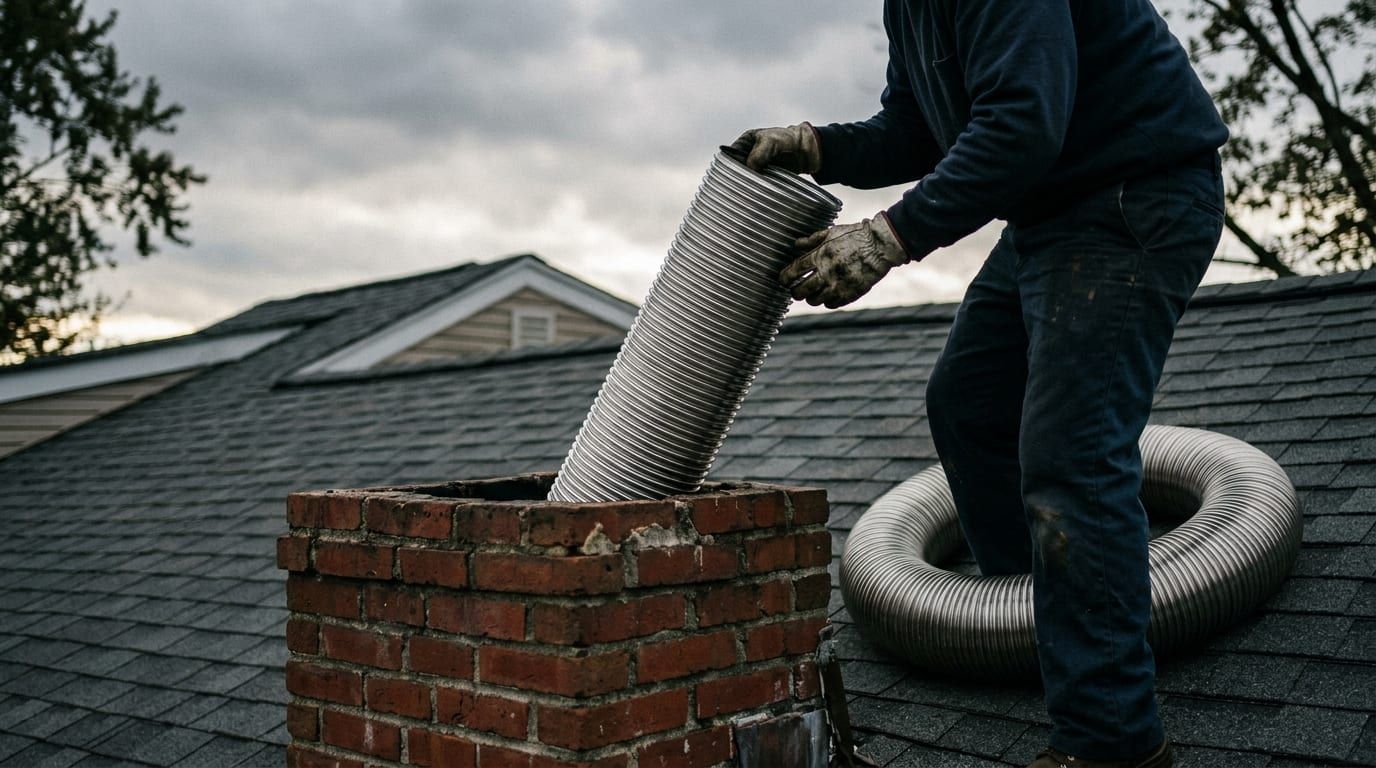
When a house converts from oil to gas, the appliance changes and the chimney usually does not. A gas boiler produces a much smaller volume of exhaust at a much lower temperature than the oil burner it replaced, and far less than the coal furnace the flue was originally built for. In a flue several sizes too large, that exhaust rises slowly, cools on the way, and condenses before it reaches the top. The condensate is acidic, and it attacks mortar joints and clay tile from inside the flue where nobody can see it. The symptoms arrive years later as white staining on the outside of the stack, brick faces that begin to flake away, a draught that has stopped working properly, or damp appearing on an interior wall. The fix is a stainless liner sized to the appliance that is actually connected rather than to the flue that happens to exist.
Why the size of a flue matters at all
A chimney works because hot gas is lighter than cold air, so it rises and pulls more behind it. That only holds while the gas stays hot enough. Put a small, cool exhaust stream into a large masonry shaft and two things work against you at once: the gas has a lot of cold surface area to lose heat to, and it is moving slowly because there is not much of it. It cools, it slows further, and somewhere on the way up it reaches the point where the water vapour in it condenses back into liquid. In a flue sized correctly for the appliance, the gas is still hot when it leaves the top and none of that happens. The size mismatch is not a detail — it is the whole mechanism.
- A flue built for coal is far larger than a gas boiler needs
- Slow, cool exhaust loses its heat to a large cold surface
- Below a certain temperature the water in it condenses inside the chimney
What the condensate actually does
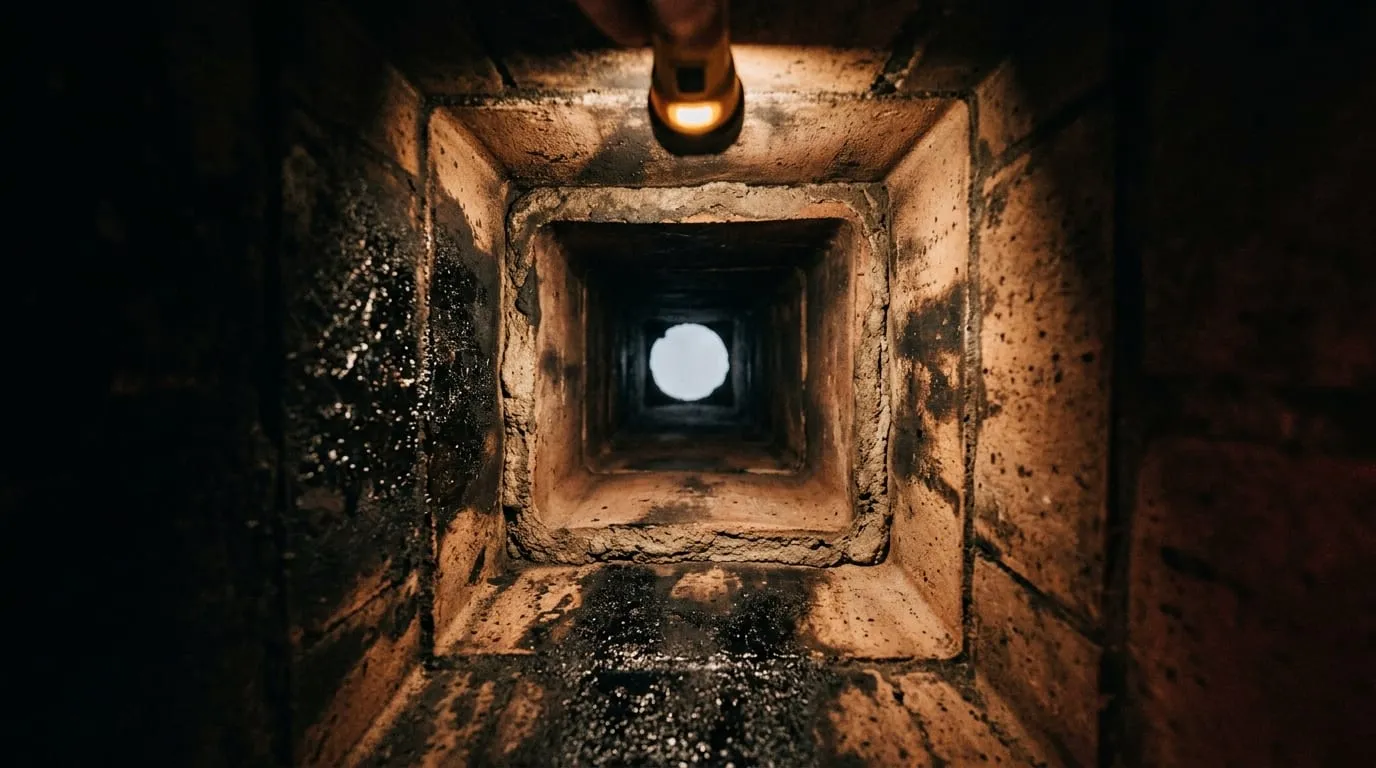
It is mildly acidic, and it has time. Running down the inside of a flue season after season it works into the mortar joints between clay tiles, softens them, and eventually opens a path into the masonry behind. From there it soaks outwards through the brickwork. That is why the first visible sign is often on the outside of the chimney rather than the inside: white mineral staining where salts have been carried through the brick and left on the surface, or brick faces that begin to spall and shed. On an interior chimney, the same water finds its way to a wall or a ceiling instead, and gets diagnosed as a roof leak because that is what a damp patch usually is.
How to tell whether it is happening in your house
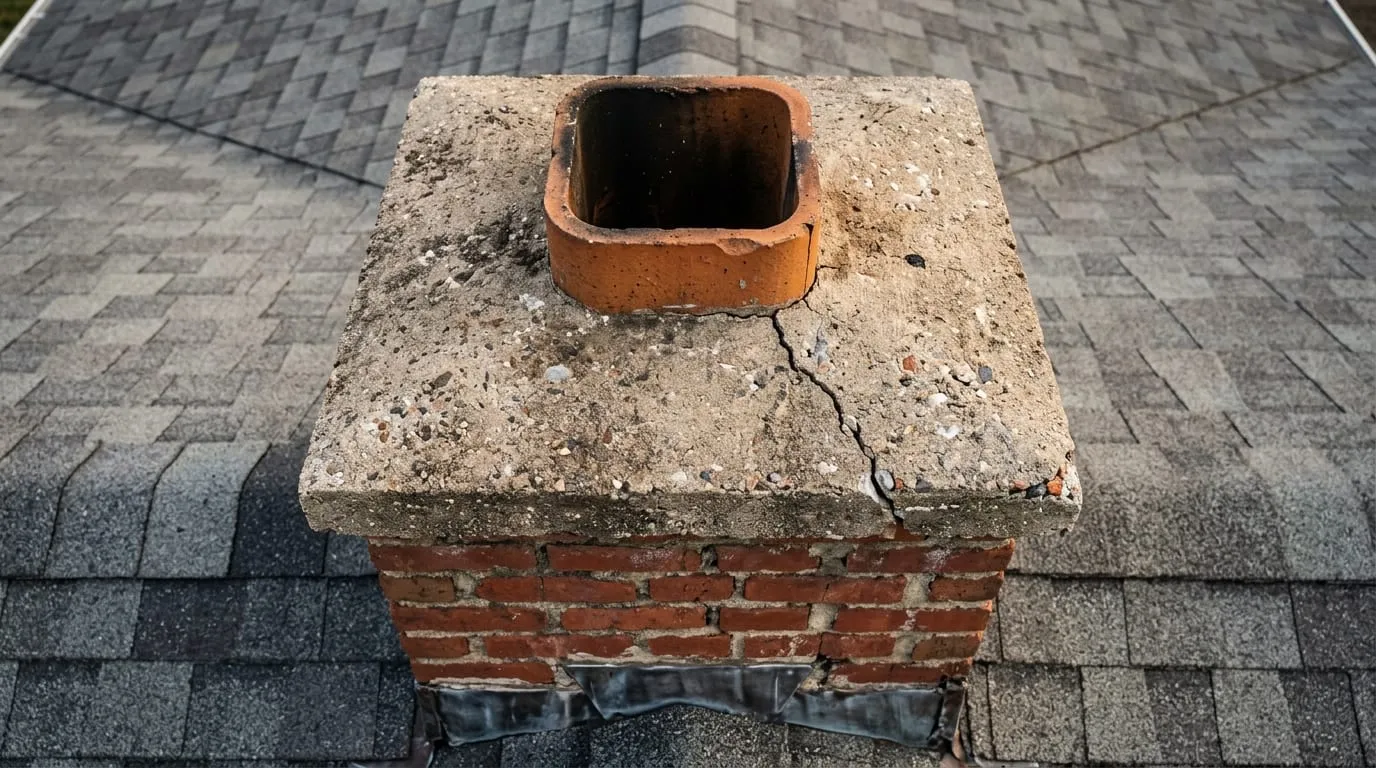
There is no way to be certain from the outside, which is why the camera exists, but there are strong indicators. If the house was built before about 1940 and the heating has been converted at least once, the odds are high before anybody looks. White staining or powdery deposit on the exterior brick of the stack is a direct sign that water is moving through the masonry. Brick faces flaking off, particularly on the weather side, is a later stage of the same thing. Inside, a boiler that has become harder to start, or a faint smell of exhaust in a basement, both point at a flue that is no longer drawing as it should. Any one of those is a reason for a scan rather than a reason to panic.
- Pre-war house plus at least one fuel conversion — start from suspicion
- White staining or powder on the outside of the stack
- Brick faces spalling, usually worst on the weather side
- A boiler that has become reluctant, or exhaust smell in the basement
What a liner does about it
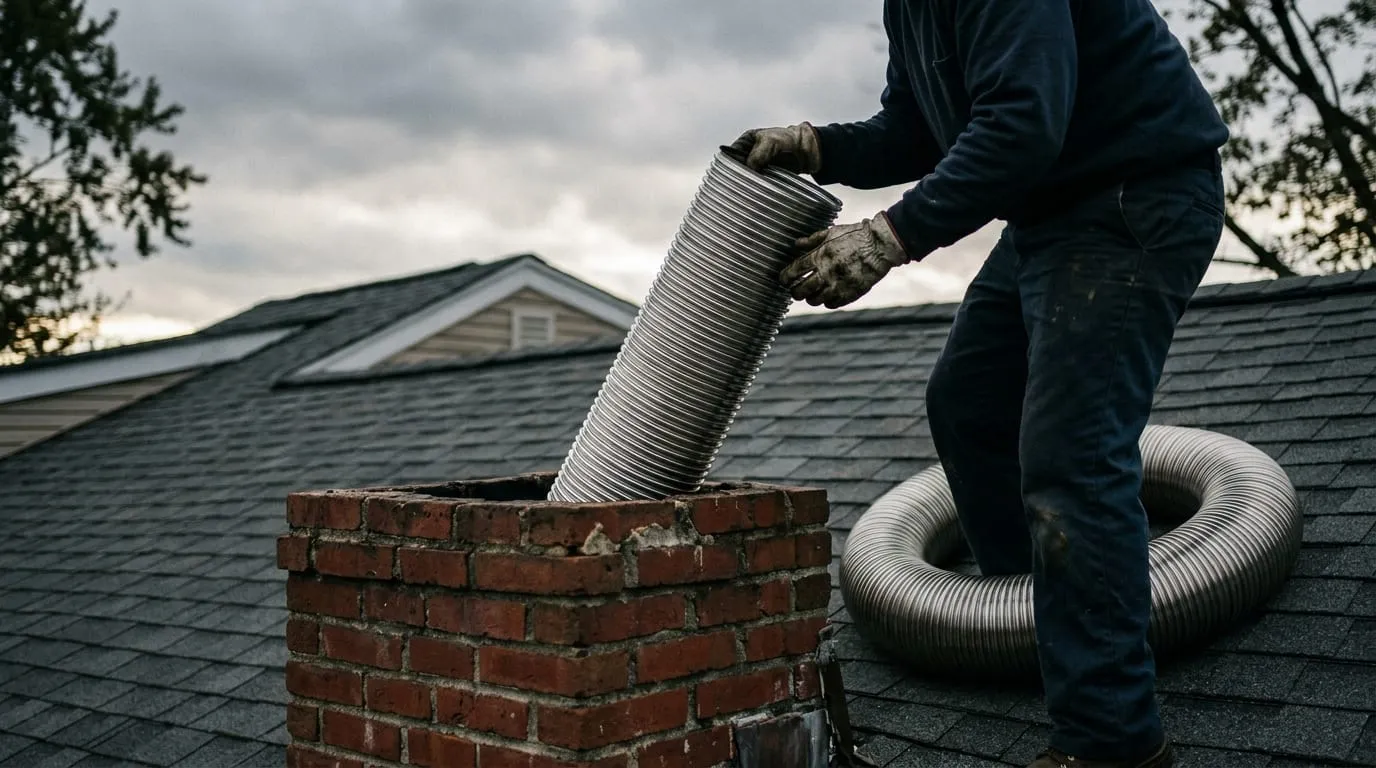
A stainless steel liner is a continuous, correctly sized shaft dropped down inside the existing masonry and connected to the appliance at the bottom. It solves the problem in two ways at once. It restores the right dimension, so the exhaust rises fast enough to leave before it cools to the point of condensing. And it puts a continuous, non-porous surface between whatever does condense and the masonry, so the chimney stops being attacked from inside. On most conversions it is also the repair that makes the chimney work properly rather than merely stop deteriorating: draught problems that had been blamed on the appliance often turn out to have been the flue all along.
When it is worth doing, and when it can wait
Not every converted chimney needs relining this year. What decides it is the state of the flue rather than the fact of the conversion. A scan that shows sound tile with intact joints, on a system that is drawing properly, is a chimney to photograph and look at again next year. A scan that shows open joints, missing mortar, or tile that has begun to break down is a chimney that is already letting exhaust into the masonry, and waiting makes the eventual job larger rather than the same job later. Where staining has already appeared on the outside of the stack, the water is through and the decision has effectively been made for you.
Questions people ask about this
My boiler was converted years ago and nothing has gone wrong. Should I worry?
Not worry — look. The damage from this is slow and silent by definition, so "nothing has gone wrong" and "nothing is happening" are not the same statement. A camera scan settles it in one visit, and a good proportion of the time the answer is that the flue is fine.
Is this the same as needing the chimney swept?
No, and it is worth separating them. Gas does not produce creosote, so a gas flue does not fill up the way a wood-burning flue does. What it does is corrode. Sweeping does nothing about that; the inspection is the part that matters on a gas appliance.
Can the old clay tiles just be repaired?
Sometimes, where the damage is local and reachable. But the underlying cause — a flue too large for the appliance — is still there after a joint repair, so the same process starts again. Relining addresses the cause rather than the current symptom.
Does an oversized flue affect a fireplace too?
Yes, differently. On a wood fireplace an oversized flue means smoke cools faster, which pushes you up the creosote scale more quickly, and it can also make the fireplace harder to start. It is one of the reasons an old fireplace that used to draw well can stop doing so.
Want somebody to look at yours?
Tell us what you are seeing and we will tell you which of these it is. We answer the phone from 7:00 AM to 9:00 PM, every day.
The services this is about
Chimney repair
A stain spreading across a ceiling is a water problem with four possible causes, and the difference between them is which one you pay to fix.
Read moreChimney inspection
An inspection is not a formality before a sweep. It is the part of the visit that decides whether sweeping is even the right thing to do, and on an older Bloomfield stack the answer is often no.
Read more