
What a hundred winters do to a chimney crown
Water gets into a hairline in November and freezes in January. Do that ninety times and the slab on top of your chimney is no longer shedding water — it is routing it into the middle of the stack.
The short answer
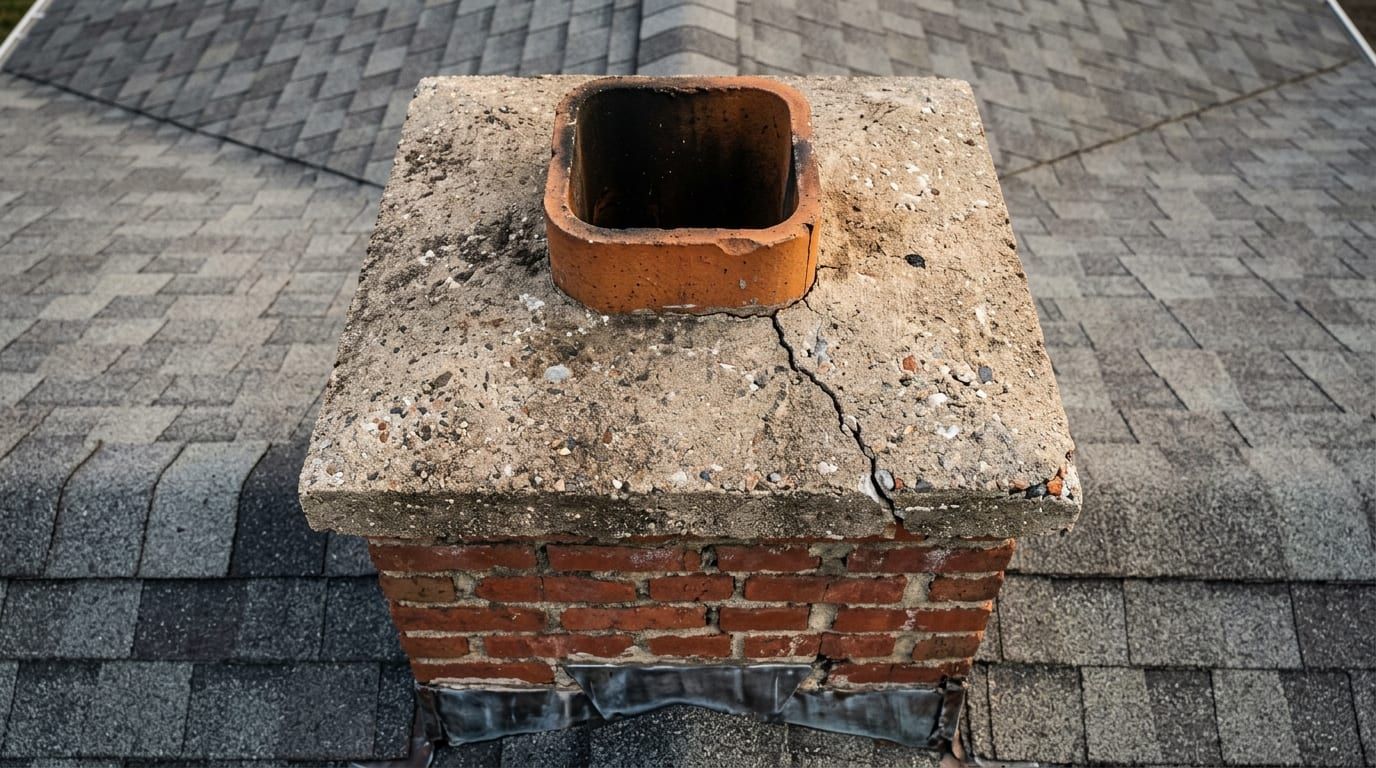
The crown is the sloped slab of concrete or mortar across the top of a chimney, and its only job is to throw water clear of the masonry below. It fails through freeze and thaw: water finds a hairline crack, sits in it, freezes, expands by roughly nine per cent, and widens the crack a fraction. Nothing happens the first winter or the tenth. On a Bloomfield chimney built before the Second World War it has now happened something close to ninety times, and the crack has reached the flue tile. Once it does, water no longer runs off the top of the stack — it runs down inside it, through the masonry, and appears as a damp patch on a ceiling somewhere that looks nothing like a chimney problem. That is why a stain in a bedroom is so often a crown, and why a skim of mortar over the top of a cracked one lasts about one season.
Crown, cap, flashing — three different things
They get used interchangeably and they are not interchangeable. The crown is the concrete slab across the whole top of the masonry, sloped so water runs off it. The cap is the metal lid sitting over the flue opening itself, keeping rain and animals out of the shaft. The flashing is the metalwork down at roof level, sealing the join where the stack passes through the roof. All three keep water out of the building and all three fail differently, which is why the first job on a leak is deciding which one you have. Being quoted for a cap when the crown has gone is common enough that it is worth knowing the words before anybody comes out.
- Crown — the concrete slab across the top, sheds water off the whole stack
- Cap — the metal lid over the flue opening, keeps rain and animals out
- Flashing — the metalwork at roof level where the stack comes through
How freeze and thaw actually takes it apart
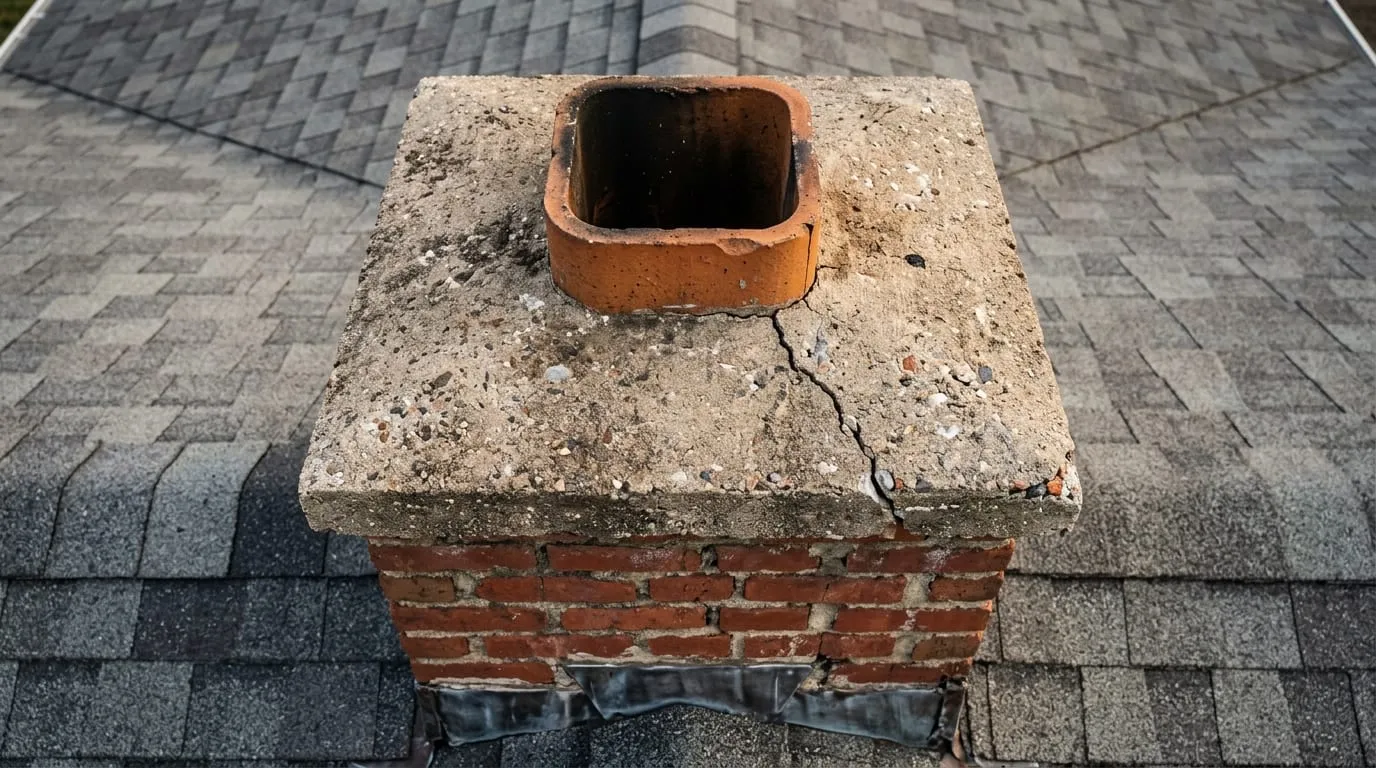
Concrete is porous and New Jersey has a climate designed to exploit that. Through autumn the crown absorbs rain. Through winter the temperature crosses freezing repeatedly — not once in a season but dozens of times, and the shallow surface of a crown follows air temperature closely. Each time water inside the slab freezes it expands and pushes the material apart very slightly; each thaw lets more water in behind it. The first visible result is surface crazing, a network of fine lines that looks cosmetic and largely is. The second is a single crack that has won, usually running from the base of a flue tile outwards, because that junction is where the slab is thinnest and where two materials that expand at different rates meet.
Reading your own chimney from the ground
You cannot diagnose a crown from a driveway, but you can decide whether it is worth somebody going up. Look at the top of the stack with binoculars or a phone camera zoomed in. A crown that overhangs the brickwork slightly and has a clean edge is doing its job. A crown flush with the brick face, or one that has lost its edge and is crumbling at the corner, is not. Then look down: white staining or powdery deposit on the brick below the crown means water is moving through the masonry, which is the crown's failure showing up further down. Brick faces flaking away, particularly on the side that takes the weather, is a later stage of the same story.
- A crown should overhang the brick slightly, with a clean edge
- White staining or powder below it means water is already through
- Flaking brick faces are a later stage, not a separate problem
Why a skim over the top is not a repair
It is the commonest thing offered and it fails for a reason that is easy to state: the movement that cracked the crown has not gone anywhere. A thin layer of mortar spread over a cracked slab is bonded to a surface that continues to move with every freeze, so it splits along the same line, usually within a winter or two. Worse, it can hide the failure for long enough that the water has time to do its work unnoticed. A crown that has cracked through to the tile wants rebuilding: taken back, reformed with a proper overhang, and given a flexible joint where it meets the flue tile so the two materials can move against each other without splitting the slab again.
The stain in the bedroom
This is where most people meet the subject. A damp patch appears on a ceiling or an upper wall, often nowhere near the fireplace, and gets treated as a roof leak. Roofers look at the roof, find it sound, and the patch returns. What is actually happening is that water is entering at the top of the stack, running down inside the masonry, and emerging wherever the structure gives it a route — which can be a floor below and several feet away. The tell is timing: a crown leak tends to follow prolonged rain rather than wind-driven rain, because it depends on saturation rather than on direction. Flashing leaks behave the opposite way. That difference is often enough to point at the right one before anybody sets a ladder up.
Questions people ask about this
How long should a chimney crown last?
A properly formed crown with a real overhang and a flexible joint at the tile can last decades. The ones failing now in Bloomfield are typically the original, formed flush with the brickwork and with no expansion joint at all, which was ordinary practice at the time and simply does not survive this many freeze cycles.
Can a cracked crown be sealed rather than rebuilt?
A hairline with no path through to the flue tile can sometimes be treated with a proper crown sealant. Once the crack reaches the tile, or the edge has begun to break away, sealing buys a season. The distinction is visible from the roof and not from below.
Is a chimney leak urgent?
It is not an emergency, but it is a problem that grows through winter rather than pausing for it. Water already inside the masonry in December will freeze and open the path further before spring, so a crown found in autumn is worth doing in autumn.
How do I know it is the crown and not the flashing?
Position and timing. Flashing leaks usually show near the chimney breast and get worse with wind-driven rain. Crown leaks show further away, sometimes a floor down, and follow long soaking rain. Neither is certain from inside, which is why the first visit is a ladder rather than a quotation.
Want somebody to look at yours?
Tell us what you are seeing and we will tell you which of these it is. We answer the phone from 7:00 AM to 9:00 PM, every day.
The services this is about
Chimney repair
A stain spreading across a ceiling is a water problem with four possible causes, and the difference between them is which one you pay to fix.
Read moreChimney inspection
An inspection is not a formality before a sweep. It is the part of the visit that decides whether sweeping is even the right thing to do, and on an older Bloomfield stack the answer is often no.
Read more